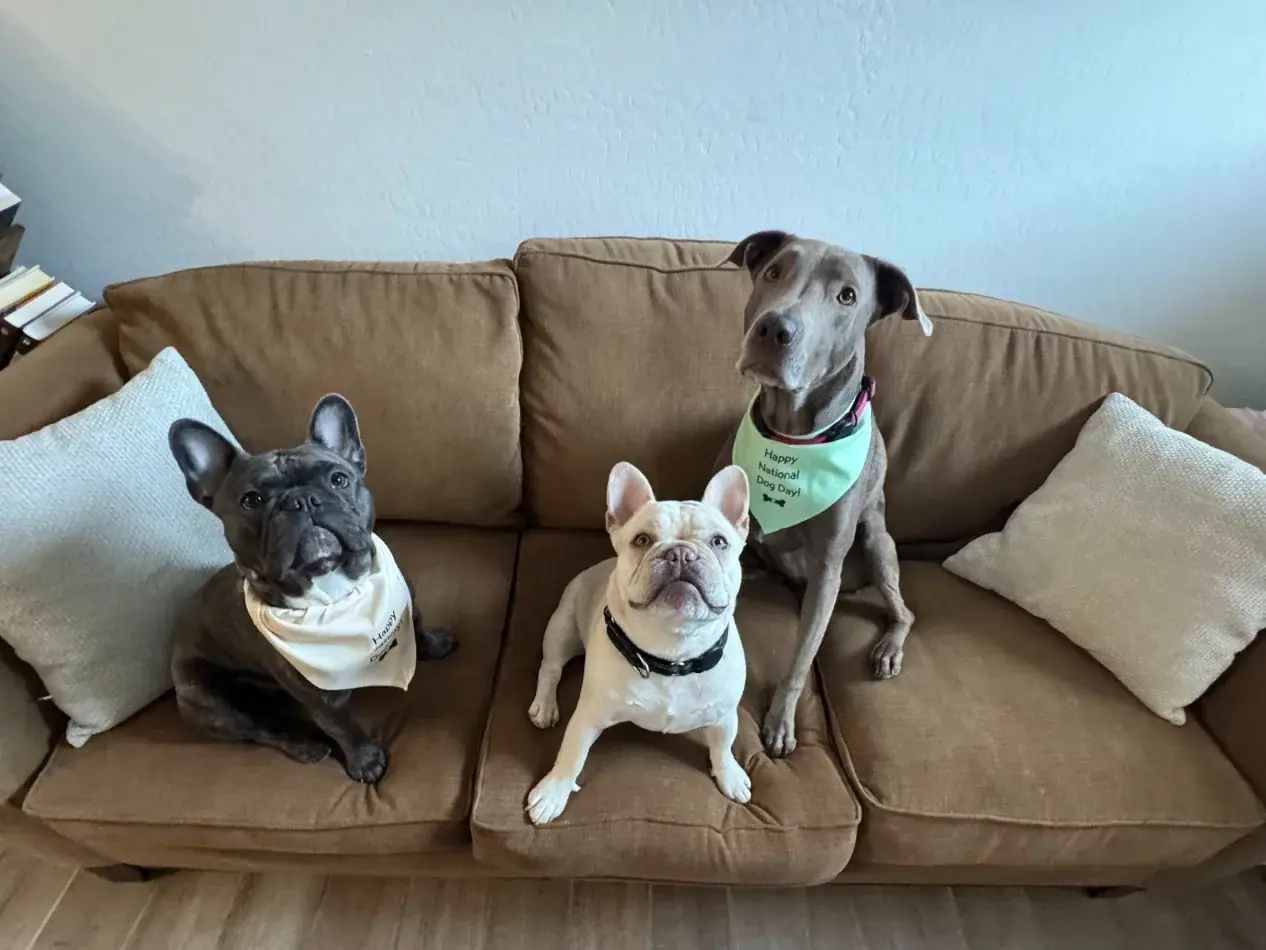
Halloween asks a lot of a dog in one evening: a costume, a bowl of candy within reach, and a doorbell that rings for hours. For flat-faced dogs like French bulldogs and pugs, the costume and the excitement deserve extra thought, because they already work harder to breathe and cool down. [1][2]
Is a costume safe for a flat-faced dog?
It can be, if it fits well and leaves the face, neck, and chest free. The ASPCA and the AVMA both say a costume shouldn’t limit your dog’s movement, sight, hearing, or breathing. [3][4]
That matters more with a flat face. Dogs cool down mainly by panting, and flat-faced breeds can’t pant as effectively because of their shorter snouts. [1] The RSPCA recommends a harness rather than a collar for these dogs, to keep pressure off the neck and help them breathe easier. [2] Apply the same thinking to a costume.
- Skip masks, hoods, and anything that covers the nose or mouth.
- Choose something light that leaves the chest free and sits loose around the neck.
- Check for small, dangling, or easily chewed pieces, which can be a choking hazard. [3]
- Try it on before the night, in short sessions. If your dog seems distressed, the ASPCA suggests a festive bandana instead. [3]
- Never leave a dog in costume unsupervised. [4]
Strenuous activity in warm weather can make a flat-faced dog’s breathing problems worse, [2] so on a warm evening, the bandana is the better call.
Which Halloween treats are dangerous for dogs?
Chocolate, anything sweetened with xylitol, raisins, and the wrappers they come in.
- Chocolate. Every kind can be dangerous, especially dark or baking chocolate. [5] Baker’s chocolate carries about seven times the stimulants of milk chocolate (about 440 mg versus 64 mg per ounce). Signs usually appear within 6 to 12 hours and can include vomiting, diarrhea, restlessness, tremors, and seizures. [6]
- Xylitol. This sugar substitute is in many sugar-free candies, gums, and mints, and in some peanut butters. [7] In dogs it can cause a sudden drop in blood sugar. Even small amounts can be dangerous, and liver damage can show up hours later. [7][8]
- Raisins. They can cause kidney failure. [4]
- Wrappers and sticks. Lollipops and candies with plastic parts and wrappers can cause an intestinal blockage. [9]
- Glow sticks. The liquid tastes extremely bitter, so a dog who bites one may drool or race around. [3] Keep glow sticks, batteries, and human costume pieces out of reach. [4]
Keep the candy bowl up high, put the trick-or-treat haul away as soon as it comes home, and use a lidded bin for wrappers.
How do I keep my dog calm when trick-or-treaters come?
Give them a quiet room away from the front door. The ASPCA says all but the most social dogs are better off in a separate, comfortable room, with a favorite chew or a food puzzle toy. [5]
- A doorbell that keeps ringing and visitors in costume can be stressful, and a closed room or crate keeps a dog from slipping out the door. [9]
- Make sure your dog has identification (a microchip, collar, and ID tag) that makes it easy for someone to reach you. [4]
- If you walk your dog that evening, use reflective gear, a secure leash, and current ID. [5] For a flat-faced dog, clip the leash to a harness. [2]
- Keep lit candles and jack-o’-lanterns out of reach, since a pet can knock one over and start a fire, and keep cords out of reach too. [4][5]
What should I do if my dog eats candy?
Call your veterinarian or an emergency veterinary service right away, before signs appear. For xylitol, the FDA says to take your dog to your vet or an emergency animal hospital immediately. [7] You can also call the ASPCA Animal Poison Control Center at (888) 426-4435, any day of the year; a consultation fee may apply. [10] It helps to tell them what your dog ate and roughly how much.
Sources differ on timing, which is one more reason not to wait. The FDA says xylitol can lower blood sugar within 10 to 60 minutes, [7] UC Davis reports signs anywhere from 30 minutes to 18 hours after eating it, [8] and chocolate signs usually start within 6 to 12 hours. [6] Signs to act on include vomiting, weakness, staggering, collapse, and seizures. [6][7]
A better default.
A quiet room, a long chew, and a bandana make a good Halloween for most dogs. The candy can stay with the people.
Educational information, not an individual veterinary assessment. If your dog needs urgent help, contact a veterinarian or emergency veterinary service rather than waiting for a reply from Boss Dog Co.
Sources
- RSPCA (UK). How to recognise and treat heatstroke in dogs. www.rspca.org.uk/adviceandwelfare/pets/dogs/health/heatstroke (opens in a new tab)
- RSPCA (UK). How to care for dogs with brachycephaly. www.rspca.org.uk/adviceandwelfare/pets/genetics/caring/dogs (opens in a new tab)
- ASPCA. Your guide to a pet-safe Halloween. October 2020. www.aspca.org/news/your-guide-pet-safe-halloween (opens in a new tab)
- American Veterinary Medical Association (AVMA). Halloween pet safety. www.avma.org/resources-tools/pet-owners/petcare/halloween-pet-safety (opens in a new tab)
- ASPCA. Halloween safety tips. www.aspca.org/pet-care/general-pet-care/halloween-safety-tips (opens in a new tab)
- Merck Veterinary Manual. Chocolate toxicosis in animals. Updated February 2026. www.merckvetmanual.com/toxicology/food-hazards/chocolate-toxicosis-in-animals (opens in a new tab)
- U.S. Food and Drug Administration. Paws off xylitol; it’s dangerous for dogs. December 2025. www.fda.gov/consumers/consumer-updates/paws-xylitol-its-dangerous-dogs (opens in a new tab)
- UC Davis School of Veterinary Medicine. Xylitol poisoning in dogs. November 2021. healthtopics.vetmed.ucdavis.edu/health-topics/xylitol-poisoning-dogs (opens in a new tab)
- Texas A&M College of Veterinary Medicine and Biomedical Sciences. Halloween pet safety. October 2016. vetmed.tamu.edu/news/pet-talk/pet-talk-halloween-pet-safety (opens in a new tab)
- ASPCA Animal Poison Control Center. www.aspca.org/pet-care/aspca-poison-control (opens in a new tab)
KEEP READING
FREE GUIDE
Every month’s Arizona risks on one page.
Heat, rattlesnakes, monsoon toads, fireworks, and holiday foods, with a source for every item.
Get the Arizona dog safety calendar →